 |
| source: ebritic.com |
Serbia, covered in snow, has drawn a line across its heart that won't melt
away when the snow melts. If I wanted to be romantic, that's how I could put
Serbia Prime Minister's decision to implement the shadowy agreement
"negotiated" between Boris Tadić's administration and the Kosovo
Albanian secessionist structures, under the watchful eye and whip of Brussels
headmaster for the Balkans school of imps, Catherine Ashton. Now, we can joke
all we want, but since yesterday, Serbia agreed to place customs checkpoints in
the middle of its internationally recognized territory.
This is not a recognition only in the fact that to recognize Kosovo, official Serbia has to say it and it didn't say it. In fact, it insists it will refuse to say. But even this advancement of the unconstitutional policy related to Kosovo changed this outsider's entire view on the degree of Serbia's ruling elites co-optation into the Western imperialist agenda against its own country and people.
In my book, the state revenue, including the customs revenue, is one of the
pillars of a state, whether that state is recognized under the selectively
upheld UN system or not. An occupying power like NATO
can indeed execute a land grab, disregarding the UN system and the internationally agreed legal
principles, but the aggrieved party, in this case Serbia, only lost the
occupied piece when it signed it over to the occupier. First Boris Tadić
violated Serbia's Constitution
by authorizing the ''footnote'' deal with Priština in February
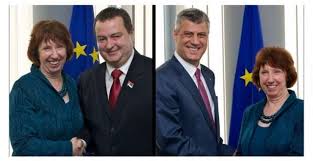
of this year, then Ivica Dačić went a step further and put his own stamp on it,
with, to make matters even more embarrassing, Hashim "the Snake"
Thaci sitting across the table and, undoubtedly, gloating. On December 10, the
first border crossing recognized as such by both sides opened up more than a year after
the North Kosovo Serbs repelled the attempt of the Albanian secessionists to do the same by force. Yes, the spin
coming out of the Serbian government's lousy PR circles is that the Jarinje
checkpoint is an administrative crossing, despite the fact that agreement under
which the embarrassment went down is flagrantly named the Integrated Border
Management. Now, one doesn't have to be an English Ph.D. to be laughing at the
attempt to spin the unspinnable using incorrect translation. I'm not laughing,
however, and neither is any Serb who recognizes the gravity of this development
that borders on treason, no pun intended.
This is an issue of Serbia sovereignty, not of policy or ideological
direction. It is even less understood when measured against the purported
justification for the capitulation, the accession to the European Union. I say
purported because even if this reason is justified, it is not immediate. Serbia
is trading Kosovo for a date to start negotiations with the EU, who, as we all
know, doesn't negotiate with its future members, but simply devours them once
it transforms their internal affairs to its liking. Serbia is trading its
sovereignty for a chance to embark on a road towards a complete loss of
sovereignty. Yes, if someone else tells you how to run your affairs, how to
make your money, how to spend your money, you have no sovereignty, regardless
of the fact that your state has its own color on the political map of Europe
and a slumbering chair in the UN General Assembly.
 |
| source: rt.com |
This is also an issue of democracy. Let's pretend for a second that people
actually do elect their political leaders and not just legitimize one group of
imperial bureaucratic servants over other groups. Boris Tadić first took the
Kosovo issue out of the jurisdiction of the UN Security Council, whose
Resolution 1244 was the only act of international law which legitimately
defined the relationship between Serbia and its occupied province. Eager to
please his whip-cracking Western masters, he happily disregarded the one
document that lent Serbia a chance to fight for Kosovo in a setting where 2 out
5 power players refused to tear down the international legal system and
recognize the Albanian secession. He violated Serbia's Constitution that relied
on 1244 when it specifically named Kosovo as its unalienable part. He allowed
Brussels to take over the Kosovo standoff without the authorization of
democratically elected National Assembly, which led to the implementation of
the Ahtisaari plan, whose draft was rejected by Serbia and internationally. We
know the consequences: EULEX arrived to Kosovo and the Albanians declared their
independence in all of Kosovo, not only in the parts they controlled. Then they
demanded recognition and the abolition of the free Serbian institutions in
North Kosovo.
Serbian patriots expected a reversal of this treasonous and undemocratic policy
with the May 20 victory of former nationalist Tomislav Nikolić and the
formation of a coalition cabinet led by Ivica Dačić, a Slobodan Milošević
disciple.
I wrote about the importance of the change and the hope that Serbia's defenses could only strengthen in comparison to the effects of the Tadić rule. In the face of knowledge that Serbia's independence in making decisions based in self-interest seriously deteriorated under Tadić, I hoped for a more balanced and sensible approach by the new administration. I was almost certain that the Kosovo and EU policies would undergo rethinking, reconsideration, if not readjustment under what was possible under the accumulated circumstances. As no administration has an obligation to affirm any part of the
policy of previous administrations, especially if the old policy was
unconstitutional, I expected the Tadić policy at least submitted to the
judicial review of the Constitutional Court, if not reversed outright. However
relieving and hopeful his decision to abandon the coalition with Tadić's
Democrat Party and form the cabinet with Nikolić's Progressives was, Dačić's
continuation and even escalation of Tadić's Kosovo policy put his cabinet on
the same treasonous course with Tadić.
Now, Dačić was a Tadić ally and a minister from 2008 to 2012, but it was clear that Tadić
had dictatorial and unconstitutional tendencies around which his cabinet, led
by Mirko Cvetković, had very little constitutional mandated independence. When Dačić,
and Nikolić for that matter, swore by their EU-affirming values in the election
campaign, it sounded so unbelievable and mind-boggling considering their past
that we waived it off as campaign rhetoric forced on them through the circumstances of political
subjugation to the EU that Tadić masochistically invited and accepted. Six
months into their joint rule, Dačić not only still swears by the EU, but keeps
going farther than Tadić in dancing to the music being played from
Brussels. I maintained hope for a period of time that Dačić, the flip-flopper that he is, could be playing all sides for the benefit of Serbia, but some lines are not to be crossed and when they are, there is no purgatory that can wash one off of the blemish of treason. Statesmanship is indeed a game of realpolitik, but it is game of trust and confidence as well. And there can be no trust in Dačić after this, with Nikolić, as supportive of Dačić's course as he's been, not instilling a lot of confidence either. If Dačić is going rogue, Nikolić sure has enough pull to sanction him. The ruling clique, however, is united behind Dačić to the point where even the insofar staunch leaders of the North Kosovo Serbs are being seen as succumbing to the new reality.
Serbia is faced with coming into the final stretch of its own
dissolution that not only rips off a part of its already-occupied territory,
but tears down its defense against such attempts in the future. Vojvodina, its
northern province that derived its autonomy from the same anti-Serbian
Communist decrees as did Kosovo, has been a target of subversive activities
hiding behind human and minority rights for some time. Raška, the region with a
relatively significant Muslim minority, has been a hotbed of fascism revival
and Wahhabi growth, two elements naturally hostile to the home state. Their
connection to the ever aggressive pan-Bosniak nationalism rooted in
radical Islam has been a manifestly growing concern to the regional stability.
The degree of brazenness with which these subversive forces operate was best
manifested in erecting a monument to the local World War II Muslim fascist
leader in Novi Pazar that went ignored by the Serbian government, which chose to look away out of fear of offending local sensibilities.
Breaking down the barriers set up by the defense of Kosovo breaks down
defenses everywhere, unless Dačić and Nikolić decided to follow the
counter-intuitive logic of Milošević and allow themselves to be convinced that
if they gave up Kosovo, the North Atlantic imperial designs would stop there,
leaving Raška, Vojvodina or Albanian-dominated municipalities in the South
Morava Valley undisturbed. Imperial designs don't stop, they get stopped.
 |
| source: grayfalcon.blogspot.com |
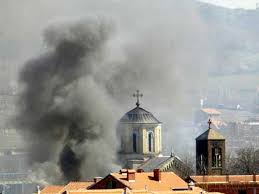
The human dimension of the disaster a Kosovo recognition would bring about
is as significant as the geopolitical one. The four municipalities of North
Kosovo, inhabited and controlled by local Serbs, which have in effect been the
target of the IBM agreement due to their unwillingness to subject themselves to
the Priština secessionist regime, are now faced with a very real ethnic
cleansing prospect. They repelled several attacks of NATO in 2011, they held a
referendum affirming their desire to remain a part of Serbia, they froze in the cold standing at Jarinje and trying to prevent the border crossing between them and Serbia from being built,
they've been shot, beaten, pepper-sprayed, yet they stood firm. In order to defend their homes, they need the help of their government and now, their government is telling them to stand down and stand over on the other side of the border.
More than 200,000 Serbs have already been cleansed from the
Albanian-controlled parts since NATO boots arrived it in 1999, while
approximately 50,000 still live in ghettoized enclaves south of Ibar River,
most of them fighting for bare survival, but refusing to abandon their
ancestral homes. Some areas have been completely cleansed of Serbs. It is clear
that the remaining enclaves are a part of the Albanian display of tolerance
intended to create an impression that Serbs can indeed co-exist with Albanians
in an Albanian-dominated society. Random unpunished murders and robberies of
isolated local Serb homes, together with the non-existence of legal system that
could even investigate the organ trafficking allegations or more than 1000
cases of murder of local Serbs, make the Kosovo Serbs unconvinced that they
won't be attacked and expelled en mass as soon as the trouble in the North is
resolved and the pretense of tolerance is not needed anymore. But check out the
continued hypocrisy of the Albanian leadership: they demand Serbia's
unconditional recognition of their sovereignty based on the fact that they
inhabit and control the land, while they refuse to bargain even over an
autonomous status within so recognized Kosovo for the North Kosovo Serbs, also
inhabiting and controlling their land. With their Western sponsors supporting
such a blatant manifestation of the logic of power against the logic of rights,
what can local Serbs expect from their Albanian neighbors but a continuation of
terror?
Seeing all this, the official Belgrade still decided to sell the lives of
Serbs in exchange for a shaky promise of a paradise lost that is the European
Union. Betraying the Constitution, abandoning its endangered citizens and
brethren, exposing Serbia to renewed aggression and butchering and doing it all
to please an imperialist structure that spent its entire history aiding
Serbia's enemies, thus becoming one - all of this begs a question: whose
interests does the Dačić administration advance? Not those of the Serbian
people. A Serb in North Kosovo is the same as a Serb in Belgrade; if you betray
the interests of one, you've betrayed the interests of all. Furthermore, if
you've violated the Constitution, you've abolished the mechanism that awarded
you the legitimacy to rule; the election that brought you to power is null and
void if the democratically adopted Constitution doesn't bind you. In short, Mr.
Dačić and all the power that derives from the power of his position ceased to
be legitimate the moment he kicked to the curb the source of that power. And if
this is correct, if the Serbian government is not bound by the interests and
democratically expressed desires of the Serbian people, the next question is:
who does it answer to? I fear the answer to this question logically and
naturally justifies not only a call for an overthrow of the illegitimate
government, but, as Thomas Jefferson wrote in the Declaration of Independence,
"when a long train of abuses and usurpations, pursuing invariably the same
Object evinces a design to reduce [the people] under absolute Despotism, it is
their right, it is their duty, to throw off such Government, and to provide new
Guards for their future security."

