Tuesday, February 5, 2013

Resilience of the North Kosovo Serbs Tested Anew


source: facebook.com/kosovskamitrovica
Two Serb children were wounded yesterday when a hand grenade was thrown at their home in the ethnically mixed neighborhood of Bošnjačka Mahala in North Kosovska Mitrovica. That's in Kosovo, the Serbian province occupied by NATO and the EU police force (EULEX) and in the context of local circumstances, it is nothing unusual. Milica (age 9) and Borivoje (age 3) Vučetić were playing in their room when the attacker threw the hand grenade through a window. The wounds were light and the children are in stable condition, although Borivoje may need blood transfusion due to the injuries to the face and neck, dangerously close to vital blood vessels. This was the second bomb attack in the town in 24 hours.

I said this is nothing unusual for the Serbs who remained in Kosovo despite daily attacks on their lives and property. And while the attacks have indeed gotten less bloody over the years - compared to the murder of children in Goraždevac in 2003 or the Pogrom of March 2004 - a new spin is being added to the crimes by the ever better trained representatives of the rogue state of Kosovo. Namely, Besim Hoti, the regional spokesman for the Kosovo Protection Corpse, the police force of the rogue state, announced today that a Serb neighbor of the attacked family has been arrested in relation to this attack. This reminded of the desecration of the Serbian cemeteries two weeks ago in Kosovo, following Serbia's removal of the Presevo monument, when the Radio-Television of Kosovo reported that it was actually the local Serbs who desecrated their own cemeteries to make themselves appear as victims of Albanian terror.

Well, over the course of more than 13 years of occupation, persecution and terror that resulted in Kosovo virtually ethnically cleansed of Serbs, they have had more than enough occasions to present themselves as true victims, but no one wanted to hear them. If no one reacted to the March Pogrom of 2004, when thousands of Serbs came under orchestrated mob attacks south of the Ibar river and had to flee or die, with the Western media ignoring or deliberately misreporting even the UNMIK statements on the bloody ordeal, why would Serbs be making up incidents of far lesser relevance and magnitude now? If the heinous murders of the boys in Goraždevac did not cause global outrage, why would anyone expect last month's destruction of the monument erected by their families in their honor to cause any objective response? Or if their murders didn't disturb hearts of the global community, why would mere flesh wounds of the Vučetić children?


source: facebook.com/kosovskamitrovica
Although Steva and Snežana Vučetić, parents of the children attacked on Monday, have expressed doubts about their neighbor's guilt, Srđan Stojanović is marked as the perpetrator, despite the fact that the KPS is neither legitimate nor objective a police entity in the eyes of the Kosovo Serbs. Not to mention the social media reports by Serb residents of the neighborhood, who alleged that Stojanović was actually the one who transported the wounded children to the nearest medical facility.

The question here is not whether anyone should outright dismiss a possibility of a Serb attacking another Serb in North Kosovo, but how truthful the reports coming from an Albanian source can be, especially in the light of KPS' general ineptitude and notorious unwillingness to deal with crimes committed against Serbs where it was believed Albanians were the perpetrators. The question is not whether there are Serbs capable of this, but whether we can trust the institutions founded in the practice of killing Serbs, raping their women, abducting them and cutting out their organs for sale. For 13 years, attacks on Serbs, their property and their cultural heritage have gone unpunished, reportedly encouraged and oftentimes orchestrated by the Albanian authorities. Serbs died, the perps walked, and that's been a fact of life in Kosovo for 13 years. Now, should the authorities with such a proven track record of disregard for the rule of law be trusted when alleging they caught the perpetrator in this instance, in an unusually short time - for their standards, at least - and he's a Serb?

The fact that weapons were found in Stojanović's home indicated to me that the Albanian police was more interested in targeting an arms-possessing potential enemy rather than looking for the attacker. Of course, that's just a speculation, albeit not an unfounded one because arrests of Serbs deemed dangerous and willing to resist the occupation are not uncommon in Kosovo.

The Vučetić family, as you can imagine, is only interested in the well-being of their children, as are all the benevolent observers, but incidents like this, in such an emotionally charged political environment have far deeper running implications for the Kosovo Serbs who persevere through the oppression and occupation. Their emotional security is being targeted now as well, whereas in the past, the attacks were limited to their lives and property. Their survival and perseverance heavily depended on the fact that it was clear to them who the enemy was, whom to defend against, and who'd have their back. Incidents like the attack on Vučetić family and the contradicting reports and allegations stemming from it sow confusion in the hearts and minds of the Serbs who see their own government in Belgrade increasingly leaning towards cutting them off. If the Vučetić family is convinced by the Albanian authorities that their Serb neighbor tried to kill their kids, while they see their president and prime minister in Belgrade wining and dining with the Albanian officials who inflicted pain and horror on their community and whose actions endangered their very survival, how can they justify not leaving their Kosovo homes or not succumbing to the pressure of giving in to the rogue Albanian authorities?

One can't find a more patriotic and resilient community than the Serbian one in North Kosovo. They have suffered through the Pogrom in 2004, constant disturbances along the lines of separation and in mixed neighborhoods, bloody attacks in the apartheid-resembling enclaves south of Ibar, and finally, attacks by NATO and EULEX, orchestrated to impose the full occupation on them and subjugate them to the NATO-puppet Albanian Kosovo. NATO and the Albanians have killed their children before, but there's never been a doubt about who the enemy was. That was the source of their resilience. With the attack on the Vučetić children, combined with the show of intent by Belgrade to abandon them, the occupiers have taken a new approach: break their spirits by confusing them and blurring the line between their friends and enemies.

Tuesday, January 22, 2013

Bringing Down the Presevo Monument

source: novosti.rs
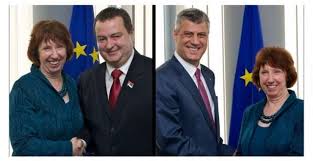
The Preševo monument has been removed over the weekend, after Ivica Dačić came back from the meeting with Hashim Thaci in Brussels. Serbs should be happy, but this Serb is far from it.
This is not a matter of Serbs never being satisfied, an argument and a sentiment used to suppress any negative public response to the move, but a matter of this Serb not being willing to buy the dilettantism and cheap populism, especially when it is sold while ignoring Serbian law.

Today, Zoran Stanković, chief of the Coordinating Body for Serbia's South, which includes the Preševo area, said that the removed monument will not be destroyed, but its fate will be discussed further, with relocation to a more suitable place as an option. Stanković also said the whole monument issue was a base for political manipulation and "an attempt to secure better negotiating positions, to use the moment in the Belgrade-Priština dialogue, because some would like to draw parallels between that area and northern Kosovo."A bargaining chip, then? If it was a chip indeed, whose chip was it?


Stanković, the man in charge of the security crisis-fertile area, appointed specifically to deal with these kinds of problems, hasn't been a player in the process, if we can even call the pissing contest and the Gendarmerie action a process. While I wholeheartedly support Serbia's resolve to protect people's sensibilities and defend itself against provocations from its hostile minority, I didn't see the removal of the monument through such a prism, as it was unclear which law was broken by its placement, who filed charges and at which court, how the legal decision to remove it was arrived to and who made it. Serbia's dealing with sensitive issue must be grounded in its law and when it is not, there must a question: to whose benefit?

The people of Serbia are happy in their fervor and oblivious to the implications of the removal and the total disregard of the law by the Dačić government. Dačić's populist maneuver worked. The rule of law failed and the Albanian provocation succeeded.

The OVPBM, the terrorist group whose fallen members the monument honored, has been amnestied by the government of Federal Republic of Yugoslavia in 2002, and the argument that the monument honored enemies of the state does not hold water, unless the amnesty excluded the killed members of the group. Anyway, since there hasn't been a legal process in which such distinctions can be defined, the public will remain in the dark as to what the hell just happened.

source: radiokim.net
To make things even more confusing, Serbia's Prime Minister didn't order a removal of the museum honoring the killed commander of OVPBM in the village of Veliki Trnovac. Wouldn't that be expected if any logic was followed? The monument to Aćif-efendi in Novi Pazar is still standing as well, even though Albanian fascists from the World War II have never been amnestied. In my mind, all three stand to offend Serbia's people equally, so why remove only one and outside of the legal process at that. The inconsistency in upholding Serbia's laws cast more doubt about patriotism of Serbia's Prime Minister and the government he heads. 

If the monument was a problem only because it was built outside of the mandated construction process, as Stanković's inexplicable offer to the Albanians to reapply for a permit seemed to imply, then why would the Prime Minister get involved? Why wasn't it resolved by appropriate construction officials? Why was their such a national attention generated by Dačić's threats and Preševo Albanians' warmongering if this just ended up being a construction permit issue?

While the Preševo Albanians, including their deputies in Serbia's National Assembly, screamed that there can be no peaceful solution to the monument crisis, across Kosovo, their brethren went on a violent rampage against Serbian cemeteries, monasteries, homes, even tearing down a monument to the fallen World War II anti-fascist fighters in the village of Vitina. So, while Serbia fails to enforce its own laws in tearing down a monument to the Albanian fascist in Novi Pazar, Kosovo Albanians go ahead and lawlessly derelict Serbia's fight against fascism, not to mentioned the continued attack on the lives and homes of Serbs. It is confusing, right? Anything that goes against logic is confusing like this. It is easy to see why the Albanians would destroy a Serbian anti-fascist symbol, attack a monastery in Đakovica and reportedly desecrate about 140 grave sites in a matter of two days; Albanians are still waging a war against Serbia, even if defenseless monuments and graves are the target, and their fascist legacies are still very much alive. Serbia, on the other hand, is not easily understood. Why would you leave a monument to a convicted fascist standing, but temporarily remove one of the monuments to the terrorists you have amnestied? Why would you amnesty terrorists is a million dollar question, asked 11 years too late...

source: vesti-online.com
Outside of populism so characteristic of Dačić, the manipulations, as Stanković called them, around the Preševo monument, served as a false show of Serbia's strength and a pretext for the Albanian leaders to mobilize popular support against Serbia, both in Priština and in Preševo. Dačić and Thaci reportedly agreed to freeze negotiations on customs levies at the North Kosovo crossings for a period of one year and, more importantly, to open the North Kosovo status as a mandatory bargaining subject of sorts. In President Nikolić's weird Platform for Kosovo, or at least in one of its versions, North Kosovo is treated as an autonomous subject under the autonomous province of Kosovo within Serbia. Unreal, ain't it? Under the recent parliamentary Resolution on Kosovo and Metohija, Kosovo is reaffirmed as a province of Serbia, but the key commitment was made to the EU path, which is contradictory in itself. Now, Thaci couldn't be expected to relinquish the hardline position regarding the North without receiving a "just" compensation. He can't sell it to his own warmongering public without a promise of getting something in return. Or is Dačić just putting fear into the Serbian public that the insistence on North Kosovo could cost Serbia the Preševo area, especially in the light of his repeated intention to dismantle Serbia's state institutions protecting Serbs in the North Kosovo municipalities? If this was a bargaining chip that Serbia bet with, how exactly will this resolution benefit Serbia?

I myself fear that the Preševo monument issue may serve to galvanize the Preševo area Albanians in asserting more of the existing desire for a unification with Kosovo, inching closer towards the goals of the Greater Albania project. The Preševo area was not an open issue until the monument charade and it will be Serbia's defeat if it does become an issue parallel with North Kosovo.

Dačić, sowing confusion, populism and inconsistency in statements and in deeds, stand to be blamed by the Serbian public for not dealing with the Kosovo - and increasingly - the Preševo problem with a higher degree of responsibility, but instead operating outside the constitutional framework and keeping the public unaware of the details of the process and its implications, while doing it all under the watchful eye and directions of Brussels imperialist bureaucrats that aided the Albanian expansion. And apparently, Serbian lives and property in Kosovo remain unprotected and exposed to all kinds of Albanian violent extremism and ethnic cleansing policies.

Thursday, January 17, 2013

The Presevo Monument: A Chip, a Decoy and an Outpost


source: voiceofserbia.org
The deadline for removal of the Preševo monument has passed without action by the men responsible to act, or at least the man who set the deadline in an outburst of verbal bravado, Ivica Dačić. Dačić threatened a forceful removal, instead of taking legal action. It was clearly smoke and mirrors, as is usually the case with Dačić's "threats." Threats of no less than a war over the monument from the Albanian side, both in Kosovo and the Preševo area, only amplified the clamor.

Serbia's government, increasingly subjugated to the will and whim of Western officials, even the low-ranking ones, like Philip Reeker of the U.S. State Department, decided to allow the monument to the men who attempted to rip off another part of it to remain standing. For the sake of charade, the Preševo municipal assembly decided to "legalize" the monument in a weird twist of Serbian jurisdictional mumbo-jumbo. Just like the monument to Aćif-efendi remained standing and just like no one talks about that formerly hot topic anymore, the Preševo monument will probably experience the same legitimization. The museum built to honor the commander of the terrorist OVPMB, which, as an extension of OVK (Kosovo Liberation Army), was thwarted in its attempt to transfer the NATO war against Serbia east of Kosovo administrative line in 2000-01, has never even been debated as an issue in the Serbian public. I don't consider the museum to be any less of a provocation against the home country by the Albanian minority than the Preševo monument. I hate when I have to substitute arguments with comparisons of this type, and I know how Americans like to think their lives are objectively more precious than lives of others, but imagine building a monument to Mohammed Atta in the lobby of the Freedom Tower. There.

The fact that Serbia's increasingly subservient prime minister cowers before any threat to his good standing with Western powers doesn't make the threat of the Greater Albania design, being materialized beyond the territory of Kosovo, any less critical. The fact that Serbia shies away from a conflict may indeed mean that the Albanian encroachment beyond Kosovo is fully supported by Western imperialists in the same way their terrorist actions in Kosovo were in 1998. Dačić is currently meeting with Hashim Thaci in Brussels and their working lunches may produce changes in the Kosovo stalemate, but considering the fact that the imperialist European Union is sponsoring the talks, there is no doubt that those changes will only benefit the Albanian side, even if in the short term Dačić is able to sell the solutions as a win.

source: nasisrbija.org
In other related news, Serbia's National Assembly adopted the Resolution on Kosovo and Metohija built on principles that were not very dissimilar to the principles Serbia was guided by in the failed Vienna talks in 2006. It will be interesting to see if Dačić, who has already allowed the Albanian customs to stand at the administrative line crossing, effectively drawing a border, obeys the Resolution in his talks with Thaci. President Nikolić's Platform has already been dismissed by both Dačić and, of course, Thaci. In Priština, any and all Serbian official lines are ridiculed and outright waved off. Albanians are not ready to negotiate, but only to accept no less than the official recognition. The EU keeps sending mixed messages but the course of its actions doesn't speak loud enough only to those paid not to hear. The EU has police presence in Serbia's occupied province without any international agreement warranting it and its mercenaries in Belgrade still dare to speak of its political missionaries as neutral, as some form of mediators. How could an occupying force be impartial in the process in which the country its armies occupy is a participant? Were the Nazi Germans impartial to their Croat cronies' genocide against Serbs? No, they allowed it and supported it. Why does anyone expect Catherine Ashton to impartially mediate talks between the side her bosses support and the one her bosses have fought a war against?

Dačić often insists on resolving the Kosovo issues once and for all. This is illogical because it puts the imperative on Serbia to strive to solve the issue that others imposed on her, while the other side is actually the one begging for a solution. The Albanians and their overlords need Serbia to affirm what they call "reality" and legitimize their aggression against her. What better absolution of sin than when the victim herself absolves the aggressor?

The Preševo monument issue may indeed play out as a bargaining chip against Serbia and for Dačić at this stage. (I say "at this stage" because no agreement made with the Albanians and their overlords is permanent. Even if the Preševo issue is a decoy now, the Preševo Valley subject will open up under the Greater Albania design eventually.) If Dačić comes back from Brussels with Thaci's nod to the Preševo Albanians to remove the monuments, whatever further concessions he makes to Thaci will be masked in the "victory" of the monument removal. As things stand now, even this is hardly likely. So, I'll quit speculating about something we will find out very soon.

source: webpublicapress.net
No matter how Dačić spins it, the policy of concessions to the EU hasn't produced anything positive and brought back only losses to Serbia. But since it is Serbia who is professing its undying desire to join the EU, the bargaining power generated by the fact that it is others asking something of Serbia is lost. With it, the power to condition the side across the table in the Kosovo haggling is gone. Thus, Dačić continues Boris Tadić's policy of allowing the Kosovo recognition in through the back door, distracting the Serbian public with side issues by amplifying them in a way that trumps real, meaningful debates about Serbia's strategy of defending its national interests.

The Preševo monument issue in itself, notwithstanding the humiliation and provocation it represented, should be irrelevant to everyone outside of Serbia's prosecutors and courts. In a country that increasingly acts like a colony, it becomes a matter of high political priority that must be resolved with the involvement of foreign ambassadors. Meanwhile, the people of Serbia sink deeper into discontent and, while Tadić's removal from power is still regarded as a definite positive, the new administration, continuing on his path in many areas, doesn't have a promising future. Voices against the Western imperial tyranny and plundering are ever louder, especially among the youth, radicalized in opposition to the continued Western aggression against the Serbian nation.

Wednesday, January 9, 2013

''Springing'' Dodik and Serb Republic's Survival

source: svevesti.com
On its 21st birthday, Serb Republic is "more stable than ever," President Milorad Dodik said. At the same time, he and his party's PR guru Rajko Vasić have been increasingly warning the public of a prospect of a violent overthrow, or a "spring" being in the works against their leadership. They cited knowledge of intensified financing of Western-sponsored NGOs in Serb Republic and their agitation among the impoverished and economically deprived segments of population, which Serb Republic, like every other country in Southeast Europe, doesn't lack.

On Tuesday, there was a condescending tone of denial in a Deutsche Welle article, written by a Bosnian Muslim and re-posted on B92 website, which, considering the outlets and the sources quoted, indicated to me that Dodik and Vasić are not merely talking crazy populism they tend to engage in every now and then. In fact, even with the notion of a violent overthrow of a government of a non-independent entity such as Serb Republic sounding so absurd and counter-intuitive, I'm inclined to regard such a prospect with fearful attention after Veran Matić's B92 jumps to mock it. Serb Republic has been under the threat of abolition since its establishment and Dodik has become a symbol of the resistance to Sarajevo's post-Dayton onslaught against the Serb entity. The Dayton Accords, which established Bosnia-Herzegovina and recognized Serb Republic as one of its two entities, had been violated consistently by the Office of High Representative and the Sarajevo central leadership prior to Dodik's second accession to power in 2006. Effectively decapitated through the political persecution of its leadership, the Serb Democrat Party couldn't withstand Sarajevo's march towards the abolition of Serb Republic in the first part of the last decade, but Dodik's return to power and his staunch and, oftentimes, abrasive attitude, has stabilized Serb Republic as a defender of the interests of Serbs west of Drina. He went so far to chastise and frown at Western envoys, and while a part of it was a show for the people and electoral rhetoric, in essence, that was the only way to repel the ever-oppressing imperial agents and their Sarajevo clients.

Considering the degree to which Dodik's burly presence, both political and personal, thwarted the abolition of Serb Republic efforts, it is understood why Western imperialist agents would want to overthrow him. One ridiculous element of the whole "spring" prospect is, as I said earlier, the fact that the Western imperialists would violently target the democratically elected government not of an independent state like Libya or Syria, or Yugoslavia in 2000, but of an entity within a state.
Dodik appears to be close to World Jewish Congress and, indirectly, to certain influencers in Israel, through his key advisor, a Holocaust survivor Arie Livne, as well as to Russian leadership and business circles. He recently closed the key energy deal with Russia's oil magnate Rashid Sardarov and the building of a new coal plant in the mining town of Ugljevik is underway. NIS (Serbia's largest oil corporation, owner by Russian Gazprom Neft) has bought Austrian OMV's gas stations throughout Bosnia-Herzegovina. He was close to Serbia's former president, Boris Tadić, but the current leadership, despite the advances he has made, has been cold towards him, with Ivica Dačić rejecting Dodik's call for a formulation of a united national political strategy. Although a staunch supporter of Serbia's refusal to recognize Kosovo's secession, Dodik repeated his proposal to divide Kosovo along ethnic lines, but that was ignored in Belgrade as well.

source: pressrs.ba
The opposition within Serb Republic to Dodik's Alliance of Independent Social-Democrats (SNSD) is mainly represented by the formerly ruling Serb Democrat Party (SDS). While SDS holds significant power at the local level, kicking SNSD's behind in most major cities' mayoral races in October, and while the entity-level political battles between SNSD and SDS are as fierce as ever, they are united in the front towards Sarajevo and usually follow the common strategy in defense of Serb Republic. Although Dodik has become the symbol of resistance against Muslim domination over Bosnia in recent years, without the support from SDS' Mladen Bosić, it would be hard for him to remain as steadfast. For the sake of Serb Republic, it is crucial that their power-sharing model, where SDS dominates on the local level and SNSD controls the higher levels, is entrenched and maintained. I haven't seen indications that SDS leadership is willing to "spring" Serb Republic and remove Dodik in the streets, but there are minor parties clinging to the margins of the political arena dominated by SNSD and SDS, whom I wouldn't put past the desire to grab power in any way possible. Out of Mladen Ivanić's Party of Democratic Progress (PDP), which has seen a precipitous decline, and former president Dragan Čavić's Democrat Party (DP), whose leader strives to reclaim lost political strength, together with the Serb Republic extension of Serbia's ruling Serbian Progressive Party (SNS), an aspiring "spring" architect could, under right circumstances, assemble a coalition of the willing and pit it against Dodik in a way they themselves, relying on their own capacities, cannot. Supported by the unions and a number of trained NGO operatives, and relying on popular mobilization spurred by a negative PR campaign, a street attack against Dodik in the mold of the one against Slobodan Milošević is not beyond a realm of a possibility.

For Serb Republic, such an event would be a disaster on many levels.
First, any instability within Serb Republic, especially one caused and orchestrated from the outside, is an invitation for vultures to come and feast on it. Serbia, right across Drina, is a cautionary tale. The robbery and the colonization of Serbia that ensued following the Milošević ouster in 2000 highly exceeded the negative aspects of Milošević's rule, however just his removal appeared to be at the time. At the time, Serbs that bulldozed Milošević out of power were not aware that CIA and NED sponsored their "revolution." A similar ouster of Dodik would almost certainly signal to Sarajevo that it is time to go for Serb Republic's jugular. I'm not even saying that no one but Dodik can secure the survival of Serb Republic, only that no foreign-sponsored overthrow of a people's choice can ever be grounded in a motivation benevolent to Serb Republic and the Serbian people. Or, from another angle, if the likes of those who conduct "springs" are going for Dodik's head, he must be doing something good for Serb Republic that its traditional, lurking enemies desire to end.

source: blic.rs
Second, anyone who advocates violence in Serb Republic is most likely an enemy of its people. Serb Republic has one top priority: survival. In the world of perceived greater and lesser evils, there is no model for its survival more appealing than power-sharing between its two major parties. The bad economic situation may continue to deteriorate and Dodik would be advised to roll up his sleeves, curb his personal greed and improve it, because he can. The increased popular outrage at the standard of living and widespread systemic corruption, and especially at Dodik's visible role in contributing to it, may indeed prove to be fertile soil for Western NGOs recruitment of cannon fodder against Dodik. Dodik must not close his eyes to this possibility, as examples of ousted leaders who refused to adjust their position in relation to their own people are too many to count.

Third, SDS, should it be drawn into a violent battle against Dodik on behalf of Western imperialists, must remember it is a party of Radovan Karadžić, because no matter what, its enemies will always remember this and if they pardon it for a short term co-optation, they will never forgive it. It must remember that the real enemy is in Sarajevo and not in Banja Luka and it must look for ways to bring Dodik to a position of cooperation for the benefit of Serb Republic. It appears Bosić is well aware of this and that's a positive.

Petar Luković, a renowned anti-Serb propagandist from Belgrade, might as well be right when he mocked Dodik and his "conspiratorial" sentiments for Deutsche Welle and dismissed it as rhetoric and even a straw Dodik is grabbing onto to preserve his power. Dodik could just be playing mind games with the people. Sure, it's possible, but since Luković called it, I doubt it. I wasn't even going to rush into commenting on Dodik's "conspiratorial" sentiments if I didn't see Luković's "analysis," in which he curiously, and I'd say, nervously, pokes fun at someone even talking about such outlandish propositions such as CIA and Vatican meddling, foreign-financed "independent" media etc. Yeah, sure, it is preposterous to think that ever happens...

Thursday, December 27, 2012

Transplanting Conflict: Presevo is Serbia!

source: wikipedia.org
Parallel with the pressure on the ever-obliging Serbia from the direction of the official Brussels, the Kosovo final solution is being pushed onto the Serbian nation, as basic principles of good conquest strategy mandate, through manufacturing of threats to escalate the conflict beyond the territory of the province. The renewed provocations against the Serbian government by the Albanian leadership at the far south of Serbia are indications of this dangerous, but tactical escalation.

As all the conflicts in the Southeast Europe are, the Kosovo conflict is just a battle in the imperial conquest of the region and the Albanians are a mere cannon fodder, which, in the short-term, get to advance some of their own nationalist agenda under the umbrella of the larger imperialist effort. Since this is a matter of the Albanian people being pitted against the regional obstacle of the North Atlantic imperial community, the Serbs, only fools can think this is a Kosovo-confined conflict. The Serbian government's troubles are not confined to Kosovo Albanians, as a small, but concentrated Albanian minority inhabit the strip of Serbia's territory outside of Kosovo, around towns of Preševo and Bujanovac in South Morava valley. This particular population has been thrown into the conflict by their Western sponsors before, during the 2000-01 uprising, and it looks like its being leveraged against Serbia again these days. (To be clear, the difference between Albanians within Kosovo and those living and operating outside of it, in the rest of southern Serbia and in Macedonia, are ethnically and ideologically non-existent. They all propagate and fight for a Greater Albania, they all serve the same imperialist agenda, whether they know it or not, and they only have slightly different short-term objectives.)

These days, the government of Serbia, which many hoped would reverse the Kosovo policy of the previous, Boris Tadić-led government, in fact intensified that approach, breaking all the rules of political engagement with secessionists and foreign oppressors, as well as its own Constitution. Ivica Dačić, the Prime Minister, has so far shown way more eagerness to comply with the demands of the European Union for the recognition of Kosovo's independence. The man who, during the election campaign, expressed willingness to use military force to keep Kosovo within Serbia, now eats lunch with Hashim Thaci, the Kosovo Albanian leader and a terrorist who still plays a key role in ripping Kosovo away from Serbia and ridding it of its Serbian population.

source: kurir-info.rs
Regardless of the fact that Dačić has been overly compliant and eager to please, the pressure on Serbia is intensifying in the form of radicalization of the Albanian population in Serbia outside of Kosovo and undermining of the state authority in the area, as if any radicalization is needed. In fact, the militant, armed groups within this population only need an order to pull the trigger.

I wrote about the monument commemorating a notorious World War II fascist in Novi Pazar, Aćif Efendi, and from this perspective, it appeared to have been just a prelude, a sort of a test for Serbia's government, which we see growing into a chain of similar provocations in the Preševo area. I might have not mentioned that Aćif Efendi, the fascist militia leader of the Novi Pazar Muslims, was an ethnic Albanian, although the Muslim militia he was leading was largely non-Albanian.

In Preševo, a monument was recently erected to honor the fallen members of the so-called Liberation Army of Preševo, Bujanovac and Medveđa (OVPBM), a KLA-organized insurgent militia whose attempt at transplantation of conflict from Kosovo to Preševo valley the Yugoslav Army and the Serbian police defeated in 2001.

In Veliki Trnovac near Bujanovac, the 2012 Albanian Flag Day - the major pan-Albanian national holiday - was commemorated with the grand opening of a museum honoring one of the killed commanders of the terrorist OVPBM, Ridvan Qazimi. On the same day, November 28, the town of Bujanovac woke up to a model of a yellow-colored house placed symbolically at the central square. Albanian organizers of the festivities, many of whom were former members of OVPBM, claimed it was a house in the Albanian city of Vlore, where the independence of Albania was declared in 1912, but to local Serbs it represented the house in northern Albania where, according to the Dick Marty report to the European Parliament, kidnapped Serbs were butchered for organs. Be it as it may, the Serbian sensibilities were seriously offended, but their Albanian neighbors didn't seem to care.

source: b92.net
Now, the main question is: outside of sensibilities, what is the problem here? Besides the fact that such forms of celebrations offend and logically radicalize, which leads to more bad blood, and in the Balkans, sow seeds to bloodshed when the imperialist powers find the bloodshed convenient, there is a huge question of the legitimacy of the Serbian government when it comes to the response to these activities.

The local glorification of an Albanian fascist in Novi Pazar was a cause for Dačić and, mainly, Aleksandar Vučić, his first deputy, to go berserk, threaten political reprisals and forget about it after several days. The plaque to an Albanian fascist still stands in Serbia. Serbia does penalize Serbian ultra-nationalist, anti-fascist and anti-EU youth, but doesn't do anything about the glorification of fascism by the leaders of a Muslim minority. It's almost blasphemous to fall short of condemning Serbia's own collaborators with Hitler, who never donned Nazi uniforms and never contributed a unit to Hitler's war efforts, but the man who under fascist insignia killed Serbs in Serbia gets a monument. Staying the course towards the EU mandates such passive behavior of Serbia's government towards attack on its legitimacy, I guess.

The three anti-Serbian manifestations in the South Morava valley have been a subject of scorn from Dačić on and off, but no definite legal action has been taken. Dačić, ever a dilettante, demanded that the Albanians who erected the Preševo monument remove it, or else. Of course, after the Aćif Efendi plaque stayed, why would the Preševo Albanians be afraid of the Serbian government and Dačić? Dačić's threats haven't materialized, of course. I'm not even saying that he should have sent police to the tear down the monument, just that he should have followed legal procedure, order the appropriate government department to investigate the matter and proceed according to law. If it's legal to erect a monument to an enemy of the State, so be it. If a glorification to an ethnic Albanian terrorist doesn't incite ethnic hatred, then let it stand. But ever a dilettante and ever a populist, he disregarded the law, took the issue out of the state institutions and conveniently did nothing with it, postponing the resolution until an opportunity to earn brownie points arises. The threats and charges swirled only to create an impression that the man who's quitting on Kosovo and dining with Thaci is actually a hard-line nationalist, even an authoritarian, with whom one doesn't mess. The parliamentary debate on the Preševo monument issue produced no results. Dačić is reviving the issue these days, primarily as a distraction in the run-up to the next round of what he called "negotiations" with Thaci, but also as a good populist way to draw attention to himself in response to President Nikolić's bargaining platform for Kosovo.

source: novosti.rs
The local Albanian leadership, however, have been throwing down a challenge: come and take it down! Encouraged by the fact that Serbia will do absolutely nothing that disappoints Brussels, not even respect its own laws, the Preševo Albanian leaders can afford to stick a finger in her eye. The smoke and mirrors display continues and the only way these monuments will be removed is as a counter-favor for Dačić leaping into a full Kosovo recognition.

The transplantation of conflict doesn't, however, get hindered with Dačić's game of interchangeable attempts at winning brownie points from the Serbian people and from Brussels. The threat of an Albanian violent expansion beyond Kosovo is real and imminent, as the Preševo valley is included in the Greater Albania designs since 1878, and as Serbian official Milovan Drecun warned on Thursday of an accumulating presence of armed militia on the Macedonian side of the border* and on the Kosovo side of the administrative line.  In 2000 and 2001, when it quelled the insurgency spilling over from Kosovo, Serbia had much more independence in acting to protect its sovereignty than in 2012. In other words, there is not one reason to believe Serbia will buy the safety of the remnants of its territory by quitting on Kosovo and the Preševo valley is the most serious contender for the next flashpoint of anti-Serbian violence.

*A third of Macedonia's population are ethnic Albanians, and the power has been shared on an equal basis between the Slav-speaking majority and the Albanian-speaking minority after the Albanian insurgence in that country in 2001.

Tuesday, December 11, 2012

Line Across the Heart: Advanced Degree of Treason


source: ebritic.com
Serbia, covered in snow, has drawn a line across its heart that won't melt away when the snow melts. If I wanted to be romantic, that's how I could put Serbia Prime Minister's decision to implement the shadowy agreement "negotiated" between Boris Tadić's administration and the Kosovo Albanian secessionist structures, under the watchful eye and whip of Brussels headmaster for the Balkans school of imps, Catherine Ashton. Now, we can joke all we want, but since yesterday, Serbia agreed to place customs checkpoints in the middle of its internationally recognized territory.
This is not a recognition only in the fact that to recognize Kosovo, official Serbia has to say it and it didn't say it. In fact, it insists it will refuse to say. But even this advancement of the unconstitutional policy related to Kosovo changed this outsider's entire view on the degree of Serbia's ruling elites co-optation into the Western imperialist agenda against its own country and people.

In my book, the state revenue, including the customs revenue, is one of the pillars of a state, whether that state is recognized under the selectively upheld UN system or not. An occupying power like NATO can indeed execute a land grab, disregarding the UN system and the internationally agreed legal principles, but the aggrieved party, in this case Serbia, only lost the occupied piece when it signed it over to the occupier. First Boris Tadić violated Serbia's Constitution by authorizing the ''footnote'' deal with Priština in February of this year, then Ivica Dačić went a step further and put his own stamp on it, with, to make matters even more embarrassing, Hashim "the Snake" Thaci sitting across the table and, undoubtedly, gloating. On December 10, the first border crossing recognized as such by both sides opened up more than a year after the North Kosovo Serbs repelled the attempt of the Albanian secessionists to do the same by force. Yes, the spin coming out of the Serbian government's lousy PR circles is that the Jarinje checkpoint is an administrative crossing, despite the fact that agreement under which the embarrassment went down is flagrantly named the Integrated Border Management. Now, one doesn't have to be an English Ph.D. to be laughing at the attempt to spin the unspinnable using incorrect translation. I'm not laughing, however, and neither is any Serb who recognizes the gravity of this development that borders on treason, no pun intended.

This is an issue of Serbia sovereignty, not of policy or ideological direction. It is even less understood when measured against the purported justification for the capitulation, the accession to the European Union. I say purported because even if this reason is justified, it is not immediate. Serbia is trading Kosovo for a date to start negotiations with the EU, who, as we all know, doesn't negotiate with its future members, but simply devours them once it transforms their internal affairs to its liking. Serbia is trading its sovereignty for a chance to embark on a road towards a complete loss of sovereignty. Yes, if someone else tells you how to run your affairs, how to make your money, how to spend your money, you have no sovereignty, regardless of the fact that your state has its own color on the political map of Europe and a slumbering chair in the UN General Assembly.

source: rt.com
This is also an issue of democracy. Let's pretend for a second that people actually do elect their political leaders and not just legitimize one group of imperial bureaucratic servants over other groups. Boris Tadić first took the Kosovo issue out of the jurisdiction of the UN Security Council, whose Resolution 1244 was the only act of international law which legitimately defined the relationship between Serbia and its occupied province. Eager to please his whip-cracking Western masters, he happily disregarded the one document that lent Serbia a chance to fight for Kosovo in a setting where 2 out 5 power players refused to tear down the international legal system and recognize the Albanian secession. He violated Serbia's Constitution that relied on 1244 when it specifically named Kosovo as its unalienable part. He allowed Brussels to take over the Kosovo standoff without the authorization of democratically elected National Assembly, which led to the implementation of the Ahtisaari plan, whose draft was rejected by Serbia and internationally. We know the consequences: EULEX arrived to Kosovo and the Albanians declared their independence in all of Kosovo, not only in the parts they controlled. Then they demanded recognition and the abolition of the free Serbian institutions in North Kosovo.

Serbian patriots expected a reversal of this treasonous and undemocratic policy with the May 20 victory of former nationalist Tomislav Nikolić and the formation of a coalition cabinet led by Ivica Dačić, a Slobodan Milošević disciple. I wrote about the importance of the change and the hope that Serbia's defenses could only strengthen in comparison to the effects of the Tadić rule. In the face of knowledge that Serbia's independence in making decisions based in self-interest seriously deteriorated under Tadić, I hoped for a more balanced and sensible approach by the new administration. I was almost certain that the Kosovo and EU policies would undergo rethinking, reconsideration, if not readjustment under what was possible under the accumulated circumstances. As no administration has an obligation to affirm any part of the policy of previous administrations, especially if the old policy was unconstitutional, I expected the Tadić policy at least submitted to the judicial review of the Constitutional Court, if not reversed outright. However relieving and hopeful his decision to abandon the coalition with Tadić's Democrat Party and form the cabinet with Nikolić's Progressives was, Dačić's continuation and even escalation of Tadić's Kosovo policy put his cabinet on the same treasonous course with Tadić.

Now, Dačić was a Tadić ally and a minister from 2008 to 2012, but it was clear that Tadić had dictatorial and unconstitutional tendencies around which his cabinet, led by Mirko Cvetković, had very little constitutional mandated independence. When Dačić, and Nikolić for that matter, swore by their EU-affirming values in the election campaign, it sounded so unbelievable and mind-boggling considering their past that we waived it off as campaign rhetoric forced on them through the circumstances of political subjugation to the EU that Tadić masochistically invited and accepted. Six months into their joint rule, Dačić not only still swears by the EU, but keeps going farther than Tadić in dancing to the music being played from Brussels. I maintained hope for a period of time that Dačić, the flip-flopper that he is, could be playing all sides for the benefit of Serbia, but some lines are not to be crossed and when they are, there is no purgatory that can wash one off of the blemish of treason. Statesmanship is indeed a game of realpolitik, but it is game of trust and confidence as well. And there can be no trust in Dačić after this, with Nikolić, as supportive of Dačić's course as he's been, not instilling a lot of confidence either. If Dačić is going rogue, Nikolić sure has enough pull to sanction him. The ruling clique, however, is united behind Dačić to the point where even the insofar staunch leaders of the North Kosovo Serbs are being seen as succumbing to the new reality.

Serbia is faced with coming into the final stretch of its own dissolution that not only rips off a part of its already-occupied territory, but tears down its defense against such attempts in the future. Vojvodina, its northern province that derived its autonomy from the same anti-Serbian Communist decrees as did Kosovo, has been a target of subversive activities hiding behind human and minority rights for some time. Raška, the region with a relatively significant Muslim minority, has been a hotbed of fascism revival and Wahhabi growth, two elements naturally hostile to the home state. Their connection to the ever aggressive pan-Bosniak nationalism rooted in radical Islam has been a manifestly growing concern to the regional stability. The degree of brazenness with which these subversive forces operate was best manifested in erecting a monument to the local World War II Muslim fascist leader in Novi Pazar that went ignored by the Serbian government, which chose to look away out of fear of offending local sensibilities.

Breaking down the barriers set up by the defense of Kosovo breaks down defenses everywhere, unless Dačić and Nikolić decided to follow the counter-intuitive logic of Milošević and allow themselves to be convinced that if they gave up Kosovo, the North Atlantic imperial designs would stop there, leaving Raška, Vojvodina or Albanian-dominated municipalities in the South Morava Valley undisturbed. Imperial designs don't stop, they get stopped.
source: grayfalcon.blogspot.com
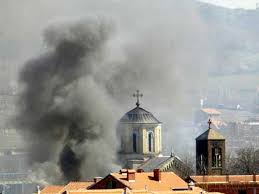
The human dimension of the disaster a Kosovo recognition would bring about is as significant as the geopolitical one. The four municipalities of North Kosovo, inhabited and controlled by local Serbs, which have in effect been the target of the IBM agreement due to their unwillingness to subject themselves to the Priština secessionist regime, are now faced with a very real ethnic cleansing prospect. They repelled several attacks of NATO in 2011, they held a referendum affirming their desire to remain a part of Serbia, they froze in the cold standing at Jarinje and trying to prevent the border crossing between them and Serbia from being built, they've been shot, beaten, pepper-sprayed, yet they stood firm. In order to defend their homes, they need the help of their government and now, their government is telling them to stand down and stand over on the other side of the border.

More than 200,000 Serbs have already been cleansed from the Albanian-controlled parts since NATO boots arrived it in 1999, while approximately 50,000 still live in ghettoized enclaves south of Ibar River, most of them fighting for bare survival, but refusing to abandon their ancestral homes. Some areas have been completely cleansed of Serbs. It is clear that the remaining enclaves are a part of the Albanian display of tolerance intended to create an impression that Serbs can indeed co-exist with Albanians in an Albanian-dominated society. Random unpunished murders and robberies of isolated local Serb homes, together with the non-existence of legal system that could even investigate the organ trafficking allegations or more than 1000 cases of murder of local Serbs, make the Kosovo Serbs unconvinced that they won't be attacked and expelled en mass as soon as the trouble in the North is resolved and the pretense of tolerance is not needed anymore. But check out the continued hypocrisy of the Albanian leadership: they demand Serbia's unconditional recognition of their sovereignty based on the fact that they inhabit and control the land, while they refuse to bargain even over an autonomous status within so recognized Kosovo for the North Kosovo Serbs, also inhabiting and controlling their land. With their Western sponsors supporting such a blatant manifestation of the logic of power against the logic of rights, what can local Serbs expect from their Albanian neighbors but a continuation of terror?

Seeing all this, the official Belgrade still decided to sell the lives of Serbs in exchange for a shaky promise of a paradise lost that is the European Union. Betraying the Constitution, abandoning its endangered citizens and brethren, exposing Serbia to renewed aggression and butchering and doing it all to please an imperialist structure that spent its entire history aiding Serbia's enemies, thus becoming one - all of this begs a question: whose interests does the Dačić administration advance? Not those of the Serbian people. A Serb in North Kosovo is the same as a Serb in Belgrade; if you betray the interests of one, you've betrayed the interests of all. Furthermore, if you've violated the Constitution, you've abolished the mechanism that awarded you the legitimacy to rule; the election that brought you to power is null and void if the democratically adopted Constitution doesn't bind you. In short, Mr. Dačić and all the power that derives from the power of his position ceased to be legitimate the moment he kicked to the curb the source of that power. And if this is correct, if the Serbian government is not bound by the interests and democratically expressed desires of the Serbian people, the next question is: who does it answer to? I fear the answer to this question logically and naturally justifies not only a call for an overthrow of the illegitimate government, but, as Thomas Jefferson wrote in the Declaration of Independence, "when a long train of abuses and usurpations, pursuing invariably the same Object evinces a design to reduce [the people] under absolute Despotism, it is their right, it is their duty, to throw off such Government, and to provide new Guards for their future security."